Generative AI's Multimodal Leap: Beyond Pixels and Prose
By Sophia Chen, TrendPulsee Staff Writer
February 7, 2026
Just a few short years ago, the buzz around Generative AI centered on its ability to conjure realistic images from text prompts or draft compelling narratives. Fast forward to early 2026, and we're witnessing a transformation far grander: Generative AI is no longer confined to single modalities. It's learning to speak, see, build, and even simulate across an astonishing array of data types, ushering in an era of true multimodal intelligence. As Sophia Chen eloquently put it in Wired, "The multimodal future is here, and AI is blurring creative boundaries in ways we've only dreamed of." This isn't just an evolution; it's a revolution.
My personal journey tracking AI has been one of constant awe, but even I'm surprised by the pace. I remember marveling at DALL-E's ability to create a 'cat in a spacesuit on the moon.' Now, we're talking about AI designing the entire spaceship from a simple sketch and a few lines of text, then simulating its flight dynamics. It's a profound shift from generating isolated artifacts to creating interconnected, functional systems.
The Dawn of True Multimodality
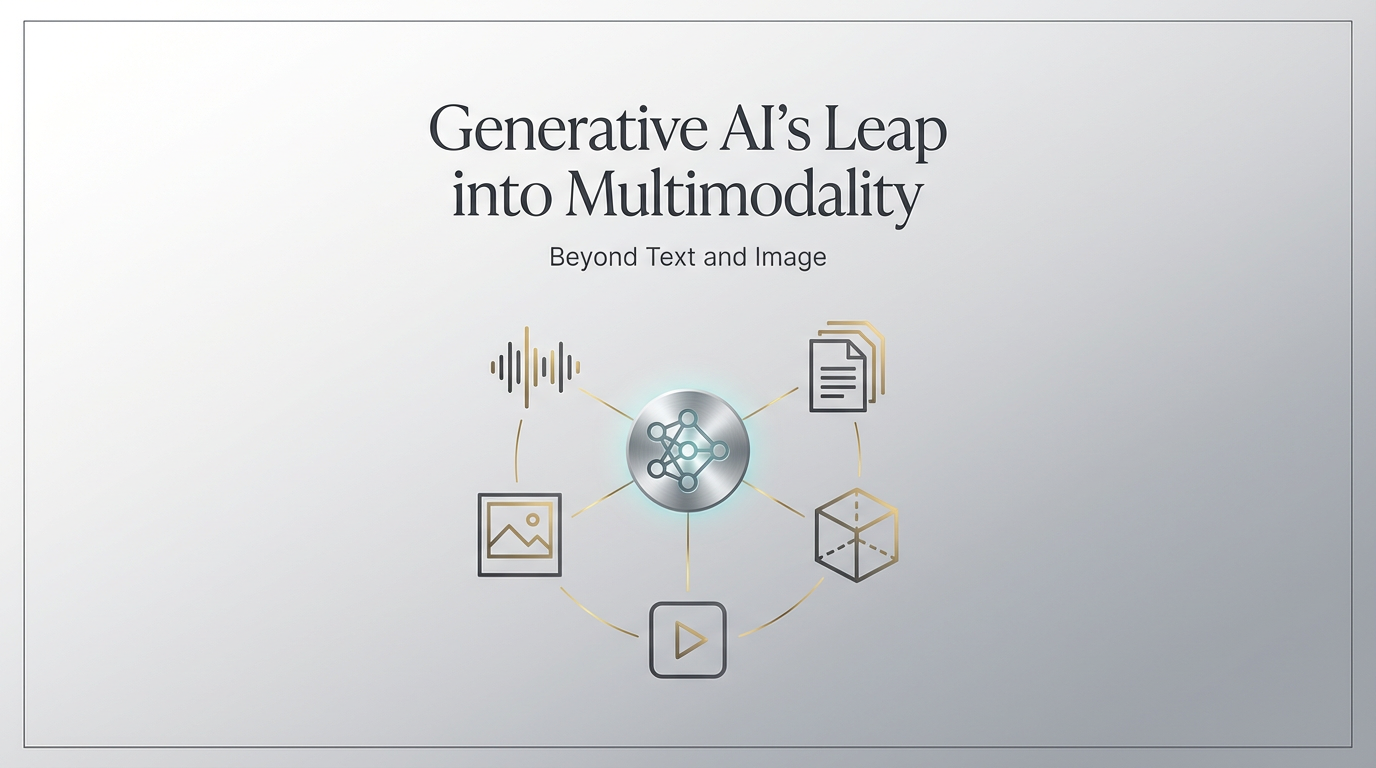
What does 'multimodal' truly mean in this context? It signifies an AI's capacity to understand, integrate, and generate content across diverse data types simultaneously. Imagine feeding an AI a photograph of a chair, a text description of its desired comfort level, and a sound clip of a creaking floor, and it then outputs a 3D model of a new, ergonomic chair, complete with material specifications and a simulation of how it would sound when moved. This isn't science fiction anymore; it's the cutting edge of Generative AI.
Leading models are now seamlessly weaving together text, images, video, audio, 3D models, and even code. This capability is powered by advancements in transformer architectures and increasingly sophisticated training methodologies that allow models to learn shared representations across different data types. The result? A single prompt can now trigger a cascade of creative outputs across multiple dimensions.
Benefits: A Creative and Functional Renaissance
The implications for various industries are nothing short of transformative. In product design and engineering, the impact is immediate and profound. As Alex Rodriguez highlighted in TechCrunch, we're moving "From Pixels to Prototypes." Designers can input a rough sketch, a list of functional requirements, and target material properties, and the AI can generate multiple 3D CAD models, complete with engineering specifications and even simulated performance data. This drastically cuts down the iteration cycle, allowing for rapid prototyping and optimization. Imagine an automotive designer sketching a new car body, and the AI instantly generates aerodynamic simulations, material stress analyses, and even a virtual reality walkthrough of the interior – all before a single physical prototype is built. This isn't just faster; it's fundamentally changing how products are conceived and refined.
For entertainment and media, multimodal AI is a game-changer. Game developers can describe a fantastical creature, provide a concept art image, and the AI can generate a fully rigged 3D model, animate its movements, create its unique sound effects, and even write dialogue for it. Filmmakers can generate entire virtual sets, characters, and even preliminary storyboards from text descriptions, significantly reducing pre-production costs and timelines. The ability to generate consistent, interconnected assets across modalities means a more cohesive and immersive creative process.
Even in scientific research and development, multimodal AI is making waves. Researchers can describe a complex molecular structure, provide experimental data, and the AI can generate 3D protein folding models, simulate chemical reactions, and even suggest new compounds for drug discovery. This accelerates discovery cycles and opens up new avenues for exploration that were previously too time-consuming or complex for human researchers alone.
Concerns: The Double-Edged Sword of Innovation
While the potential is exhilarating, my personal insights also compel me to acknowledge the significant challenges and ethical considerations. The power of multimodal AI is a double-edged sword.
Firstly, there's the issue of control and bias. If an AI is trained on vast datasets that reflect existing societal biases, those biases will be amplified and propagated across all generated modalities. An AI designed to create architectural plans might inadvertently favor certain cultural aesthetics or structural designs, potentially marginalizing others. Ensuring fairness and representativeness in training data becomes exponentially more complex when dealing with diverse modalities.
Secondly, the authenticity and provenance of content become incredibly murky. If an AI can generate hyper-realistic videos, audio, and even 3D objects from simple prompts, distinguishing between AI-generated and human-created content will become increasingly difficult. This has profound implications for misinformation, deepfakes, and intellectual property. Who owns the copyright of a 3D model generated by an AI based on a human's text prompt and a few reference images? These are questions that legal frameworks are ill-equipped to answer currently.
Furthermore, the potential for job displacement is a very real concern. While multimodal AI empowers creators, it also automates tasks that were once the exclusive domain of highly skilled professionals – 3D artists, sound designers, animators, and even entry-level engineers. While new roles will undoubtedly emerge, the transition could be disruptive for many.
Finally, the computational resources required to train and run these sophisticated multimodal models are immense, raising environmental concerns and exacerbating the digital divide. Only well-funded organizations can currently afford to push the boundaries of this technology, potentially centralizing power and control.
The Path Forward: Balancing Innovation with Responsibility
The leap into multimodal Generative AI is undoubtedly one of the most significant technological advancements of our time. It promises to unlock unprecedented levels of creativity, efficiency, and problem-solving across virtually every sector. The ability to translate abstract ideas into tangible, functional outputs across diverse forms is a testament to the rapid progress in AI research.
However, as we embrace this exciting future, it is paramount that we do so with a strong sense of responsibility. We must prioritize ethical AI development, focusing on bias detection and mitigation, developing robust content provenance tools, and fostering public discourse around the societal implications. The conversation cannot just be about what AI can do, but what it should do, and how we ensure its benefits are broadly distributed.
My take? The multimodal future is here to stay, and it will redefine our relationship with technology and creativity. It's a powerful tool that, if wielded wisely, can usher in an era of unparalleled innovation. But like any powerful tool, it demands careful stewardship, thoughtful regulation, and a continuous commitment to human values. The next few years will be critical in shaping whether this revolution truly serves humanity's best interests.
Key Takeaways
- •This article covers the most important insights and trends discussed above
Sophia Chen
Tech journalist and content creator